


Affiliate disclosure: This article may contain affiliate links. If you purchase through these links, we may earn a commission at no extra cost to you. We only recommend resources that are relevant to puppy training and dog care.

First-Time Puppy Owner? Start With These Simple Training Basics
Bringing home a new puppy is exciting, but it can also feel a little overwhelming.
One moment your puppy is sleeping peacefully, and the next they are chewing a shoe, having an accident on the floor, barking for attention, or biting your hands during play. If this is your first puppy, it is easy to wonder whether you are doing things right.
The good news is that puppy training does not need to be complicated.
You do not have to teach everything at once. In the beginning, the most important things are simple: help your puppy feel safe, build a routine, reward good behavior, and gently teach the habits you want them to repeat.
This beginner’s guide will walk you through the basics of puppy training so you can start with confidence.
Start With a Calm Routine
Puppies learn faster when life feels predictable.
A regular routine helps your puppy understand what happens next. It also makes toilet training, feeding, sleeping, and early obedience much easier.
Try to create a simple daily pattern for:
- feeding times
- potty breaks
- naps
- playtime
- short training sessions
- bedtime
Young puppies need a lot of sleep. An overtired puppy can become more bitey, noisy, and difficult to manage. Sometimes the answer is not more training — it is simply a quiet nap.
Your routine does not have to be perfect, but it should be consistent enough for your puppy to begin recognizing the rhythm of the day.
Begin Potty Training From Day One
Potty training should start as soon as your puppy comes home.
Your puppy will not understand the rules at first, so your job is to guide them patiently. Take them to the same outdoor potty area often and praise them when they go in the right place.
The most important times to take your puppy out are:
- first thing in the morning
- after meals
- after drinking
- after waking from a nap
- after play
- before bedtime
- whenever they sniff, circle, or seem restless
When your puppy goes potty outside, reward them immediately with praise or a small treat. Timing matters because your puppy needs to connect the reward with the behavior.
If your puppy has an accident indoors, stay calm. Do not shout or punish. Clean the area properly and take them out more often next time.
Accidents are part of learning, especially in the early weeks.
Use Positive Reinforcement
Positive reinforcement simply means rewarding the behavior you want to see again.
This could be with:
- small treats
- praise
- play
- a favorite toy
- attention
- being allowed outside
- a chance to sniff on a walk
Puppies repeat behavior that brings good results. If sitting calmly earns attention, your puppy is more likely to sit calmly again. If coming when called brings praise and a treat, your puppy is more likely to come back next time.
The key is to reward quickly and clearly.
You do not need to bribe your puppy forever. Treats are most useful in the early stages when your puppy is learning what words and behaviors mean. Over time, you can also use praise, toys, and everyday rewards.
Keep Training Sessions Short
Puppies have short attention spans.
A training session does not need to last 20 minutes. In fact, for a young puppy, that is usually far too long.
Two to five minutes at a time is often enough.
You can do several short sessions throughout the day. For example, you might practice “sit” before meals, name recognition during play, or “come” in the hallway.
Short sessions help your puppy stay interested and successful.
Always try to end on a good note. If your puppy is getting tired, distracted, or frustrated, stop and try again later.
Teach the Most Useful Commands First
You do not need to teach a long list of commands in the beginning.
Start with the basics that make everyday life easier and safer.
Good first commands include:
Name Recognition
Say your puppy’s name in a cheerful voice. When they look at you, reward them.
Your puppy’s name should mean, “Pay attention — something good is about to happen.”
Sit
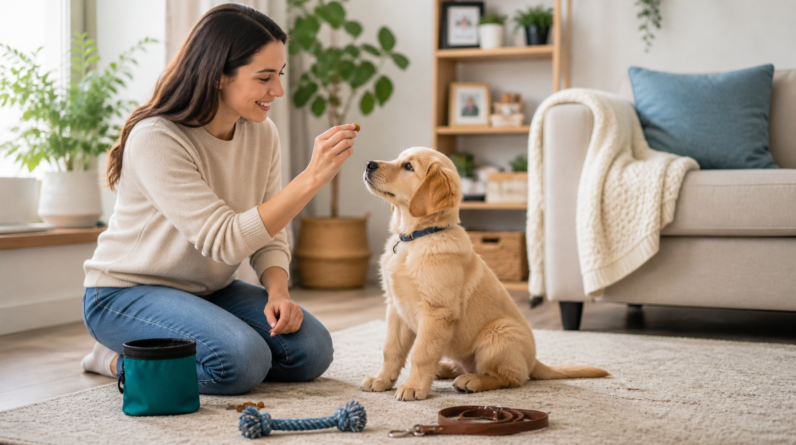
“Sit” is useful before meals, greetings, and attention. Use a small treat to guide your puppy’s nose upward and slightly back. As their head follows the treat, their bottom will often lower naturally. Reward as soon as they sit.
Come
Recall is one of the most important safety skills. Start indoors where there are few distractions. Call your puppy in a happy voice and reward them when they come to you.
Never call your puppy to punish them. Coming to you should always feel positive.
Leave It
“Leave it” helps stop your puppy from picking up unsafe or unwanted objects. Start with easy practice indoors and reward your puppy for turning away from something tempting.
Wait
“Wait” helps with impulse control. You can use it before meals, at doors, or before your puppy greets someone.
Manage Biting and Chewing Calmly
Puppy biting and chewing are normal.
Puppies explore the world with their mouths, especially when they are teething, excited, or tired. This does not mean your puppy is bad or aggressive. It means they need guidance.
If your puppy bites your hands or clothing, redirect them to a chew toy.
If they keep biting too hard, calmly pause the game. This teaches them that gentle play continues, but rough biting ends the fun.
You can also prevent chewing problems by keeping tempting items out of reach. Shoes, socks, phone chargers, remote controls, and children’s toys are all common puppy targets.
Give your puppy safe chew toys and praise them when they chew the right things.
Socialize Your Puppy Gently
Socialization is an important part of puppy training, but it is often misunderstood.
It does not simply mean letting your puppy meet as many people and dogs as possible.
Good socialization means helping your puppy feel safe and confident around everyday life.
This may include:
- different people
- household sounds
- car rides
- visitors
- grooming
- different floor surfaces
- outdoor noises
- calm, friendly dogs
- new environments
The goal is not to overwhelm your puppy. The goal is to create positive experiences.
If your puppy seems worried, slow down. Let them observe from a comfortable distance and reward calm behavior.
Confidence grows best through gentle exposure, not pressure.
Be Consistent With House Rules
Puppies learn faster when the rules are clear.
If one person allows the puppy on the couch and another person does not, the puppy becomes confused. If jumping up gets attention sometimes but not other times, the puppy does not understand what is expected.
Try to agree on simple rules from the beginning.
For example:
- Where will your puppy sleep?
- Will they be allowed on furniture?
- How will you respond to biting?
- What command words will everyone use?
- How will you handle jumping up?
- Where should the puppy go potty?
Consistency does not mean being harsh. It means giving your puppy clear, repeated guidance.
Avoid Common First-Time Puppy Mistakes
Most new puppy owners make mistakes. That is normal.
The important thing is to recognize them early and adjust.
Common mistakes include:
- expecting too much too soon
- giving the puppy too much freedom in the house
- training for too long
- punishing accidents
- not rewarding good behavior
- allowing biting during play
- being inconsistent with rules
- forgetting that puppies need lots of rest
Your puppy is learning everything from the beginning. Patience matters.
Final Thoughts
Puppy training is not about creating a perfect dog overnight.
It is about building trust, creating routine, and teaching good habits step by step.
Start with the basics: potty training, name recognition, short training sessions, positive rewards, gentle handling, and clear house rules.
Your puppy will make mistakes. You will have frustrating days. That is part of raising a young dog.
But with patience, consistency, and kindness, your puppy will gradually learn what is expected and grow into a calmer, happier, better-behaved companion.
For more helpful puppy training guides, explore the rest of our Training section and follow the step-by-step articles for new puppy owners.

