


Affiliate disclosure: This article may contain affiliate links. If you purchase through these links, we may earn a commission at no extra cost to you. We only recommend resources that are relevant to puppy training and dog care.

Puppy Training Schedule by Age: What to Teach Your Puppy Month by Month
Bringing a new puppy home is exciting, but it can also feel confusing. One day your puppy seems eager to learn, and the next day they are chewing everything, ignoring their name, or having accidents indoors.
The good news is that puppy training becomes much easier when you understand what to teach at each stage of your puppy’s development.
A young puppy does not need complicated training. In the beginning, the most important lessons are simple: where to toilet, how to feel safe, how to respond to their name, and how to start building good daily habits.
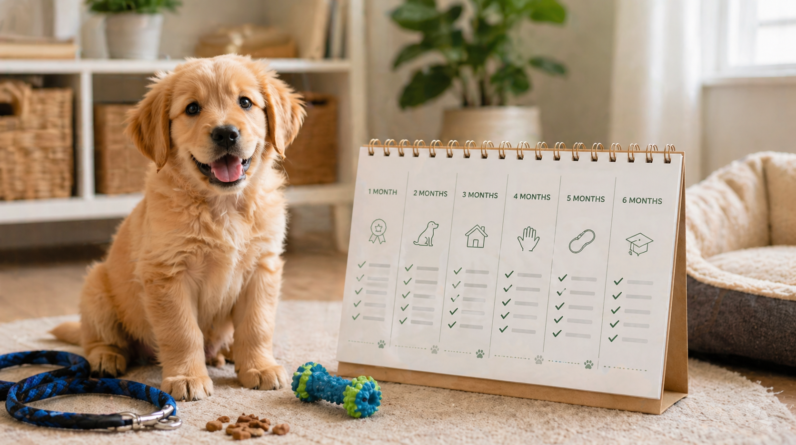
This puppy training schedule by age gives you a simple guide to what you can focus on month by month.
8 to 10 Weeks: Settling In and Building Trust
Most puppies arrive in their new home around 8 weeks old. At this age, your main job is not advanced obedience. Your main job is helping your puppy feel safe.
Everything is new: the house, the people, the sounds, the smells, and the routine. Your puppy may cry at night, follow you everywhere, or seem nervous at first. This is normal.
At this stage, focus on:
- Teaching their name
- Starting toilet training
- Creating a feeding routine
- Introducing a crate or safe sleeping area
- Gentle handling
- Short play sessions
- Rewarding calm behaviour
Training sessions should be very short — often just 2 or 3 minutes at a time. Use a cheerful voice, gentle praise, and small treats.
Toilet training begins immediately. Take your puppy outside after waking, after eating, after drinking, after playing, and before bedtime. Praise them warmly when they toilet in the right place.
Do not expect perfection. At 8 to 10 weeks, your puppy is still a baby.
10 to 12 Weeks: Simple Commands and Routine
By 10 to 12 weeks, your puppy may be more confident and curious. This is a good time to introduce very simple commands.
Good early commands include:
- Sit
- Come
- Their name
- Leave it
- Gentle
- Wait
You do not need to teach everything at once. Start with one or two basics and build slowly.
“Sit” is usually one of the easiest commands. Hold a treat near your puppy’s nose, then slowly move it upwards and slightly back. As their head follows the treat, their bottom will often lower naturally. As soon as they sit, say “sit” and reward them.
This is also a good age to continue socialisation. Socialisation does not only mean meeting other dogs. It also means helping your puppy get used to everyday life: household sounds, different surfaces, visitors, traffic noises, car journeys, grooming, and being calmly handled.
Keep every experience positive and gentle.
3 Months: Confidence, Lead Practice and Bite Control
At around 3 months old, many puppies become more energetic and playful. This is often when biting, chewing and jumping up become more noticeable.
This does not mean your puppy is being naughty. They are exploring the world with their mouth, testing boundaries, and learning how to behave.
At this age, focus on:
- Reducing puppy biting
- Encouraging calm play
- Practising short lead walks
- Building recall
- Continuing toilet training
- Rewarding polite greetings
If your puppy bites your hands during play, redirect them to a toy. If they become overexcited, pause the game. Puppies need to learn that gentle play continues, but rough biting ends the fun.
Lead practice can begin indoors or in the garden before longer walks. Let your puppy wear a collar or harness for short periods, then introduce the lead gently. Reward them for walking beside you, even for just a few steps.
Recall is also important. Begin indoors by calling your puppy in a cheerful voice. When they come to you, reward them. Never call your puppy to punish them, as this teaches them that coming to you can lead to something unpleasant.
4 Months: Better Manners and More Structure
At around 4 months, your puppy may start to understand routines more clearly. They may also become bolder, more independent, and more easily distracted.
This is a good time to strengthen everyday manners.
Useful lessons include:
- Waiting before meals
- Sitting before attention
- Walking calmly on the lead
- Coming when called
- Settling quietly
- Leaving objects alone
- Accepting grooming
Your puppy should now be having slightly more structured training sessions, but still keep them short. Several 5-minute sessions throughout the day are better than one long session.
This is also a good age to teach “settle”. Encourage your puppy to relax on a mat, bed, or blanket. Reward calm behaviour. This is especially useful if your puppy gets overexcited in the evenings.
Remember that your puppy is still young. Progress may not be steady every day. Some days they will seem brilliant; other days they may forget everything. That is completely normal.
5 Months: Distractions and Consistency
By 5 months, your puppy is likely becoming stronger and more confident. They may start pulling on the lead, ignoring commands outside, or becoming excited around people and other dogs.
This is the stage where consistency matters.
Your puppy may understand commands indoors but struggle outdoors. That is because the outside world is full of distractions. Do not assume they are being stubborn. They are learning to listen in more difficult situations.
At this stage, practise:
- Recall in safe areas
- Loose lead walking
- Ignoring distractions
- Calm greetings
- Longer waits
- Leave it around tempting objects
Use higher-value treats when training outside. A normal biscuit may work in the kitchen, but outdoors your puppy may need something more exciting.
Keep rewarding the behaviour you want. Puppies repeat what works.
6 Months and Beyond: Teenage Puppy Training
Around 6 months, many puppies enter an adolescent phase. This can be challenging. A puppy that once followed you everywhere may suddenly become more independent. They may test boundaries, ignore recall, or become more excitable.
This is not failure. It is a normal development stage.
At this age, continue working on:
- Reliable recall
- Calm lead walking
- Staying settled
- Not jumping up
- Waiting at doors
- Ignoring distractions
- Good behaviour around visitors
- Calm behaviour around other dogs
Do not stop training just because your puppy knows the basics. This is the time to reinforce them.
Training should become part of daily life. Ask for a sit before meals. Practise recall in the garden. Reward calm behaviour when visitors arrive. Use everyday moments as training opportunities.
The Most Important Rule: Train the Puppy in Front of You
Every puppy develops at a different pace. Some puppies learn toilet training quickly. Others take longer. Some are confident from day one. Others need more reassurance.
Do not compare your puppy too much with others.
A puppy training schedule is a guide, not a strict rulebook. The aim is to help you know what to focus on at each stage, without expecting too much too soon.
The best puppy training is calm, consistent and positive.
Final Thoughts
Training your puppy by age helps you avoid overwhelm. Instead of trying to teach everything at once, you can focus on the right lessons at the right time.
In the first weeks, build trust and routine. Then add simple commands, socialisation, lead practice, manners, and more reliable obedience as your puppy grows.
With patience and consistency, your puppy will learn what is expected and grow into a calmer, happier, better-behaved dog.

